
By CampusTrack Team
Construction Workforce Management in UAE: Attendance, Compliance, and Payroll
The UAE construction sector employs one of the largest and most mobile workforces in the country. With thousands of workers spread across multiple project sites, many employed through subcontractors, and strict WPS and UAE Labour Law compliance requirements, managing attendance in construction is uniquely complex. Manual methods simply cannot keep up — and the cost of inaccuracy is measured in compliance penalties, payroll disputes, and project delays.
Why construction attendance is different
Construction workforces have characteristics that make standard attendance systems inadequate. Workers are distributed across multiple active project sites, and these sites change as projects start and finish. A single construction company may have workers at 5 sites today and 8 sites next month. The workforce is highly mobile — workers may be reassigned between sites based on project needs. Many workers are employed through subcontractors, creating multiple layers of employment relationships. Shifts are often long (10 to 12 hours) and may include night work. And the outdoor environment means traditional fingerprint scanners are unreliable — dust, moisture, and rough hands cause frequent failed reads.
The compliance landscape
UAE construction companies face particularly stringent compliance requirements. The Wage Protection System (WPS) requires accurate salary payments for every employee, calculated from actual hours worked. UAE Labour Law conducts site inspections and can request attendance records for any worker at any time. The UAE midday work ban (outdoor work prohibition during peak summer hours, typically 12:30 PM to 3:00 PM from June 15 to September 15) must be tracked and documented. Companies that cannot demonstrate compliance face fines, work permit suspensions, and potential blacklisting.
For companies with subcontracted workers, the compliance challenge is even greater. The principal contractor may be held accountable for subcontractor compliance failures, making it essential to have visibility into subcontractor workforce attendance as well.
GPS geofencing for construction sites
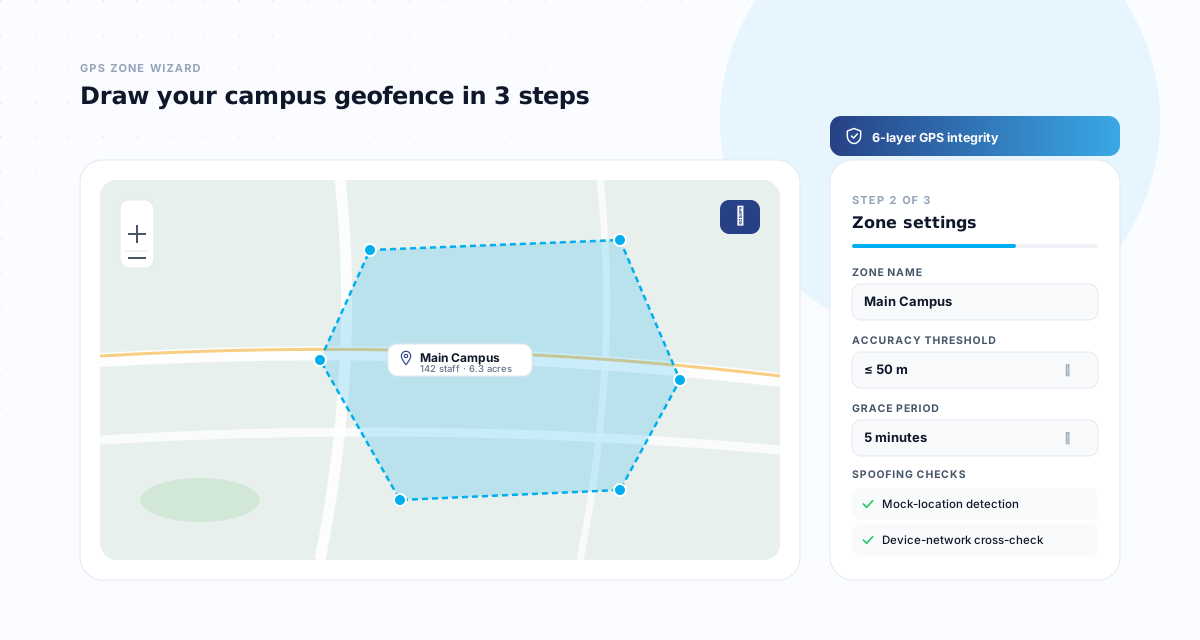
GPS-based attendance is particularly well-suited for construction because it adapts to the temporary, distributed nature of project sites. Each active site is defined as a geofence — a virtual boundary set using GPS coordinates. When a worker arrives at the site and opens the attendance app on their phone, the system verifies that their GPS location falls within the designated site boundary. The geofence radius can be configured per site, accommodating everything from a compact building plot to a large infrastructure project spanning several kilometres.
When a project is completed and the site closes, the geofence is simply deactivated. When a new project starts at a different location, a new geofence is created in minutes. There is no hardware to install, relocate, or decommission — a significant advantage in an industry where sites are inherently temporary. This hardware-free attendance model is the reason GPS-based systems now dominate UAE construction deployments.
Face recognition for identity verification
Buddy punching — one worker clocking in for another — is a well-documented problem in construction. With large workforces and high turnover, it is difficult for site supervisors to personally verify every worker's identity at every shift. Phone-based face recognition solves this by requiring each worker to verify their identity using the phone's camera at check-in. The system matches the live face against the enrolled photo, providing approximately 98% accuracy in good lighting conditions. Combined with GPS verification, this creates a dual-factor authentication that confirms both identity and location.
Automated timesheets for payroll and WPS
One of the most time-consuming aspects of construction workforce management is converting attendance data into payroll-ready timesheets. With workers on different shifts, overtime rates, and project assignments, manual timesheet preparation is slow and error-prone. An automated attendance system generates timesheets directly from check-in and check-out data. Total hours, overtime hours (calculated according to UAE Labour Law definitions), and site assignments are all captured automatically.
These automated timesheets can be exported in formats compatible with payroll systems and WPS-approved channels. This eliminates the manual data re-entry that is a primary source of payroll errors. For companies processing payroll for hundreds or thousands of workers across multiple sites, the time savings alone justify the investment.
Managing subcontractor workforces
Construction projects typically involve multiple subcontractors, each with their own workforce. A central attendance system can accommodate this by assigning workers to their respective subcontractor entities within the same platform. The principal contractor gets visibility into overall site attendance, while each subcontractor manages their own workers. Reports can be generated per subcontractor for billing verification — confirming that the subcontractor actually deployed the agreed number of workers for the agreed hours.
Real-time alerts and visibility
Construction site managers need to know immediately if a crew is short-staffed — not at the end of the day when they review a report. Real-time dashboards show who has checked in at each site, who is late, and who has not arrived. Automated alerts can notify site supervisors when a worker fails to check in within the expected window, enabling immediate action: calling the worker, arranging a replacement, or adjusting the day's work plan. For safety-critical operations where minimum crew sizes are mandatory, this real-time visibility is essential.
Getting started
For construction companies evaluating attendance systems for construction, the key criteria are: GPS geofencing that supports multiple simultaneous sites, face recognition that works outdoors in varying conditions, the ability to handle large workforces (hundreds to thousands of workers), subcontractor management capabilities, automated timesheet generation for WPS-compatible payroll, and mobile-first design since construction workers rarely have access to desktop computers. A pilot at one active site, run in parallel with the existing attendance method for one payroll cycle, is the most practical way to validate the system before a company-wide rollout. For a deeper look at why site teams are moving away from fingerprint readers, see our guide to attendance systems without hardware.
Looking for construction workforce attendance?
That is AiyaHR, our sister platform for non-education sectors — GPS geofencing, face recognition and automated timesheets for multi-site construction operations in the UAE. CampusTrack itself is built for schools.
See construction attendance on AiyaHRFrequently asked questions
How does GPS attendance work on a construction site without WiFi?
GPS uses satellite positioning, not WiFi — it works anywhere a phone gets a clear sky view, including remote labour camps and roadworks. CampusTrack caches check-ins offline on the device and uploads them as soon as the worker’s phone reconnects to a 4G/5G signal, so attendance is never lost on sites with patchy connectivity.
Is CampusTrack WPS-compliant for construction payroll?
Yes. CampusTrack timestamps every check-in and check-out, calculates overtime per Federal Decree-Law No. 33 of 2021, and exports timesheets in formats accepted by the WPS bank file generation tools used by UAE payroll providers. The exported records are signed with the supervisor who approved them, satisfying WPS audit requirements.
Can a supervisor check in workers from one phone for the whole crew?
Yes. CampusTrack supports a supervisor mode where one phone can register attendance for an entire crew using face verification — useful when individual workers don’t carry phones on site. Each captured face is matched against the worker’s stored template, so the supervisor cannot mark the wrong person.
What if the construction site does not have any biometric scanner?
CampusTrack does not need a biometric scanner. Workers (or a supervisor) check in from a phone using GPS plus face verification. This is why the system is popular on construction sites where installing a fingerprint device is impractical — site offices move every few months, dust kills sensors, and gloves prevent fingerprint reads.