
By CampusTrack Team
Staff Attendance System for Dubai Schools: Compliance, Operations & Beyond
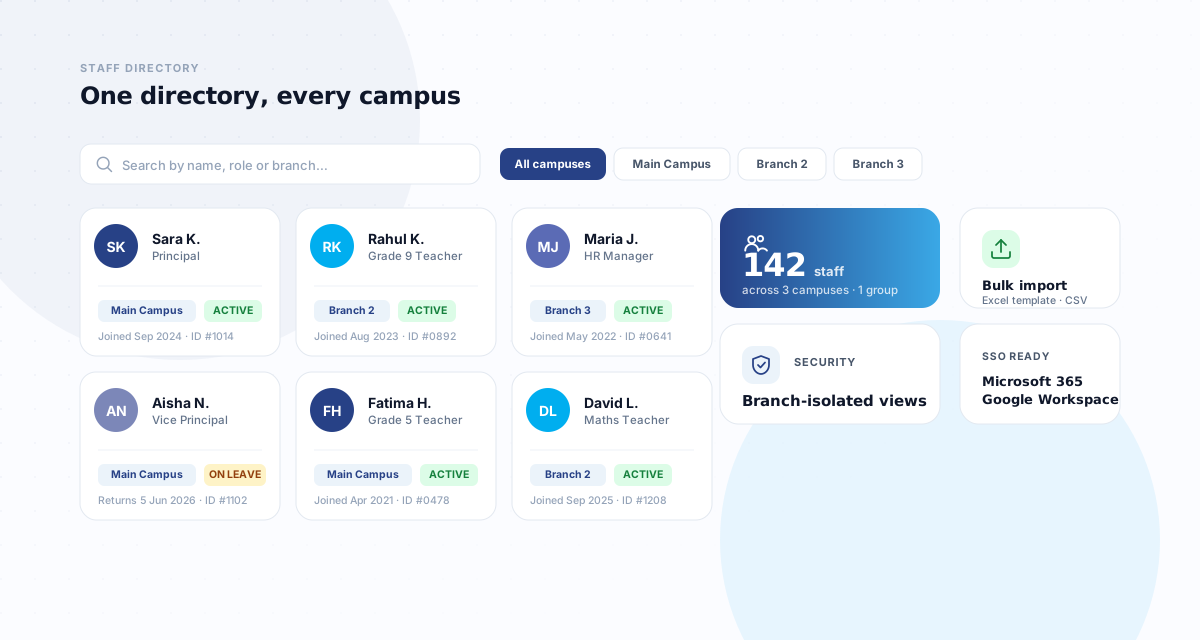
Dubai's private schools operate under one of the most structured regulatory environments in the region. Dubai school regulatory framework oversees school quality through Dubai school inspections that evaluate teaching, governance, and operational effectiveness. While Dubai school inspection's attendance reporting focuses on students, the operational outcomes of staff attendance — classroom coverage, substitute readiness, staffing ratio compliance — are assessed indirectly. Beyond inspections, schools are employers under UAE Labour Law, with the same working hour and record-keeping obligations as any company. For school leaders, a reliable staff attendance system is both a legal compliance requirement and an operational necessity.
Why schools need digital attendance
Traditional staff attendance methods — paper sign-in sheets, basic fingerprint scanners, or manual registers — are increasingly inadequate for modern school operations. Dubai school inspections can request staff attendance records with minimal notice, and inspectors expect organised, verifiable data. Paper records are difficult to audit, prone to errors, and impossible to cross-reference against leave records, substitution schedules, or payroll. A purpose-built teacher attendance system closes these gaps with timetable-aware check-in, leave integration, and audit-ready exports.
UAE federal education regulations also set requirements for staff-to-student ratios and minimum instructional hours. If a school cannot demonstrate accurate teacher attendance records, it may struggle to prove compliance with these standards. Beyond regulatory requirements, school groups operating multiple campuses in Dubai need centralised visibility — knowing which staff are present at which campus, in real time, across the entire group.
What inspections evaluate in operational governance
During Dubai school inspections, evaluators assess whether schools have effective governance and management practices. Staff attendance records are not a direct inspection metric, but the consequences of poor attendance tracking — inadequate staffing, no substitute coverage data, inability to demonstrate operational control — can impact governance ratings. Inspectors typically look for evidence of consistent daily operations, adequate staff coverage, properly maintained leave records, and the ability to produce staffing data on request.
Key features for school attendance systems
Schools have specific requirements that differ from general corporate attendance systems. GPS geofencing is valuable not just for campus boundary verification but also for field trips and off-site events — a capability also used in construction and multi-site operations — teachers accompanying students to external venues can still check in, and the system records their location. Face recognition provides contactless identity verification, which is particularly important in school environments where hygiene standards are high and shared-device contact should be minimised.
Multi-branch support is essential for school groups operating under a single brand with multiple campuses. The system should provide branch-level isolation (each campus principal sees only their staff) alongside group-level reporting (the group director sees all campuses). Role-based access control ensures that class coordinators, department heads, principals, and group administrators each see only the data relevant to their role.
Attendance correction workflows are important in school settings where staff may arrive through different entrances, attend morning assembly before reaching their desk, or have duties that take them away from the main check-in point. A system that allows employees to submit correction requests — with manager approval and an audit trail — handles these scenarios without compromising data integrity.
Implementation tips for schools
Roll out the system at the start of an academic term, not mid-year. This gives staff a clean starting point and avoids the complexity of migrating partial-year data. Begin with the administrative and support staff — they typically have the most straightforward schedules — before onboarding teaching staff with their more complex timetables. Configure the system with school-specific work calendars that account for UAE public holidays, school-specific holidays, professional development days, and exam periods.
Train reception and HR staff first, as they will handle day-to-day queries. Then run brief orientation sessions for all staff, focusing on how to check in, how to submit correction requests, and who to contact if something goes wrong. Keep the process simple — if checking in takes more than 10 seconds, adoption will suffer.
Common mistakes schools make
The most frequent mistake is choosing a system designed for corporate offices and expecting it to fit school operations. Schools have unique patterns: split shifts for some staff, different arrival times for early years versus secondary teachers, duty rosters that change weekly, and term-based contracts alongside annual contracts. A generic system that only tracks clock-in and clock-out will not capture these nuances.
Another common mistake is failing to integrate attendance with leave management. If a teacher is on approved sick leave but their attendance record shows them as absent (rather than on leave), the data creates confusion during audits. The attendance system should reflect approved leave automatically, without manual intervention from HR.
Finally, schools sometimes underestimate the importance of mobile access. Teachers and support staff are not sitting at desks all day — they are in classrooms, corridors, playgrounds, and buses. A system that requires walking to a specific device to check in creates bottlenecks and missed entries. Phone-based check-in solves this entirely.
Beyond compliance: operational value
While Dubai school inspection-readiness is the immediate driver, a good attendance system delivers operational value that goes far beyond inspections. Accurate attendance data feeds directly into payroll, reducing errors and disputes. Real-time visibility helps principals manage substitutions when staff are absent. Historical attendance data supports performance reviews and contract renewal decisions. And for school groups, centralised reporting provides the group leadership with data-driven insights across all campuses.
UAE Labour Law: the actual compliance requirement
While inspection readiness gets attention, the direct legal requirement for staff attendance tracking comes from UAE Labour Law. Federal Decree-Law No. 33 of 2021 requires employers — including schools — to maintain accurate records of working hours, overtime, and leave balances. The Wage Protection System (WPS) requires payroll accuracy, which depends on attendance data. UAE Labour Law inspections can request attendance records at any time. Schools are subject to the same general record-keeping rules as any other Dubai employer — for a broader look at employer obligations, see our overview of the Dubai attendance system landscape. For more on how inspections assess schools, see our operational readiness guide for school inspections.
Non-compliance with these requirements can lead to legal exposure, wage disputes, and UAE Labour Law penalties. This makes staff attendance a compliance necessity independent of school inspections.
Looking for a school-focused attendance system?
CampusTrack is built specifically for schools — with multi-campus support, role-based access, and inspection-ready compliance reporting.
See how CampusTrack works for schoolsFrequently asked questions
Is CampusTrack Dubai school inspection-ready for Dubai schools?
Yes. CampusTrack stores attendance, leave, and overtime records in formats Dubai school inspectors expect during Dubai school inspection visits — exportable to PDF or Excel by date range, by branch, or by individual staff member. The audit trail captures every correction with the timestamp and the user who made it, satisfying Dubai school record-keeping expectations.
Can a Dubai school use CampusTrack without buying biometric devices?
Yes — that is the default deployment. Staff check in from their own iOS or Android phones using GPS geofencing plus AI face verification. Most Dubai schools save AED 18,000–25,000 per campus by skipping fingerprint scanners and the recurring maintenance contracts that come with them.
Does CampusTrack work across multiple Dubai school branches?
Yes. CampusTrack is multi-campus by design. Each branch has its own GPS zones, working hours, and admin team, while group leadership sees a consolidated dashboard across all campuses. Branch-level data isolation prevents one campus from accidentally seeing another’s records.
How much does a school attendance system cost in Dubai?
CampusTrack offers a free plan for schools up to 50 staff and a paid plan at a flat AED monthly rate per site, with no per-employee fees. our cloud infrastructure provider hosting is billed separately at roughly AED 350 per month. Most Dubai schools deploy in under two weeks with no hardware purchase.