
By CampusTrack Team
Attendance System for Colleges and Universities in the UAE
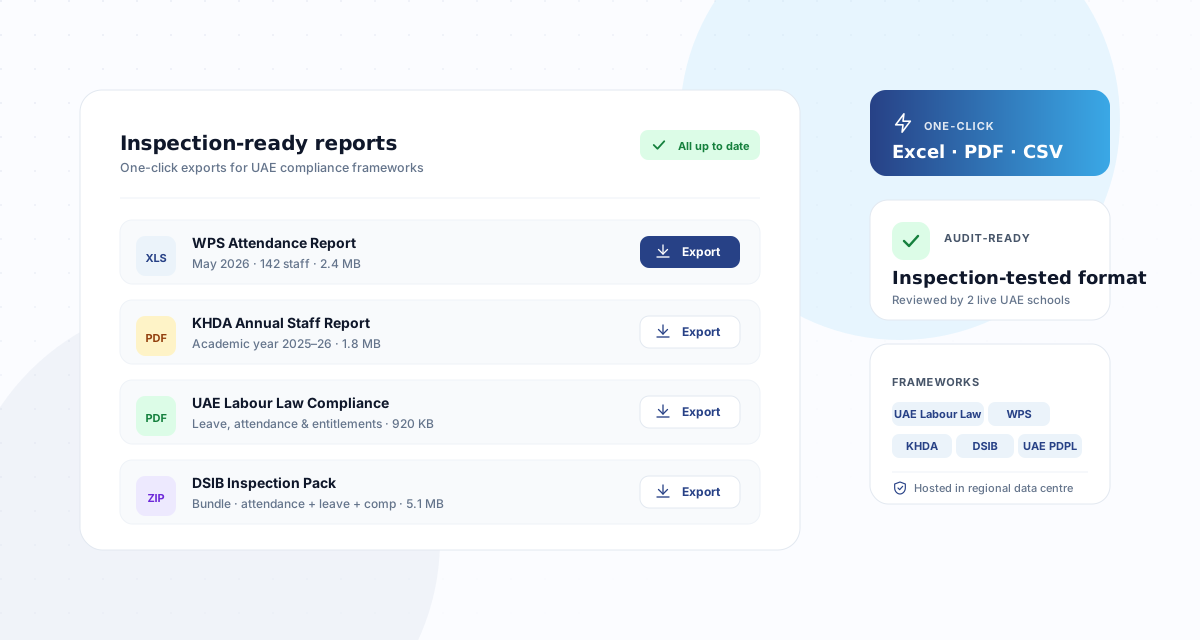
UAE colleges and universities run very differently from K-12 schools. They have bigger campuses, more departments, mixed full-time and part-time staff, lab schedules, and complex academic calendars. A purpose-built attendance system handles all of this at once.
How higher education differs from K-12
K-12 schools usually have one campus and a fixed daily schedule. Most staff are on site for most of the school day. (For K-12 guidance, see our article on staff attendance systems for Dubai schools.)
Universities work differently in three big ways:
- Spread-out campuses. A single university often covers many buildings across a large area, with different faculties in different zones.
- Varied teaching schedules. A professor might teach Mon, Wed, Thu — research on Tue — and have no obligations on Fri.
- Part-time and lab staff. Adjuncts may be on campus only a few hours a week. Lab staff follow lab availability, not class timetables.
Admin and support staff — registration, library, IT, facilities — follow steadier schedules, but they sit in different buildings. The result: many different attendance patterns under one roof.
Staff attendance needs in higher education
Zone-based GPS
One geofence for the whole campus is too coarse. Each major building should have its own zone — engineering, library, admin block, sports complex.
The system then records not just that a staff member is on campus, but which zone they checked in from. For an adjunct who must be in a specific building for class, this confirms they are in the right place.
Face recognition
Universities have hundreds of staff. Security and admin teams cannot recognise every face. Phone-based face recognition handles this at scale, with no contact needed. It matters most for visiting faculty, who may not be known to campus staff yet.
Department-level reporting
The right people should see the right data:
- The Dean of Engineering sees engineering faculty.
- The Director of Libraries sees library staff.
- The Vice Chancellor sees a consolidated view across all departments.
The system must mirror the university’s structure, so each level sees only what they need.
Managing part-time and adjunct faculty
Part-time faculty are a big share of teaching staff at many UAE universities. They are usually paid by the hour or by the course. So accurate attendance feeds directly into payroll.
The system should capture real campus hours — verified by GPS and face. Reliable hours mean fewer payroll disputes and fairer pay.
Adjuncts who teach at more than one institution add a twist. They check in wherever they are teaching that day. A system with multiple geofences handles this without manual setup — each campus is its own zone.
Integration with academic calendars
Academic calendars differ from business calendars. Several types of period change attendance expectations:
- Semester start and end dates
- Exam periods
- Inter-semester breaks
- Research weeks
- Graduation ceremonies
The system must reflect these periods. During exams, for example, academic staff may have very different on-campus duties than during teaching weeks. A good system supports period-specific rules instead of flagging every change as an exception.
Conferences, professional development days, and sabbaticals add more nuance. A staff member at an approved conference is on duty, not absent. The system should support multiple absence types — leave, conference, sabbatical, research offsite — each with its own approval flow.
Regulatory considerations
UAE higher-education institutions answer to several regulators:
- CAA — Commission for Academic Accreditation (federal level)
- Dubai school regulatory framework — Dubai institutions (some)
- Emirate authorities — Abu Dhabi, Sharjah, and others
These bodies often check staffing levels, faculty-to-student ratios, and Labour Law compliance for non-academic staff. Accurate, auditable attendance records support all three.
Data protection matters too. Under the UAE Personal Data Protection Law (PDPL), face templates and GPS coordinates count as personal data. So the attendance vendor should:
- Store data inside the UAE or an approved jurisdiction
- Use clear consent flows
- Publish a data retention policy
Implementation recommendations
When you roll out a digital attendance system — explore the full CampusTrack feature set — work in this order:
- Admin and support staff first. Their schedules are the steadiest, so the rollout is the easiest.
- Full-time academic staff next. Roll out by department once the basics are validated.
- Part-time and adjunct faculty last. Onboard them after the configuration is proven.
Involve IT early if you need to integrate with HR or student information systems. And tell staff why the system exists — accurate records and fair pay, not surveillance.
Looking for attendance management for higher education?
CampusTrack supports multi-zone campuses, department-level reporting, and flexible schedules designed for colleges and universities.
See how CampusTrack works for educationFrequently asked questions
Can UAE colleges and universities use CampusTrack for faculty attendance?
Yes. CampusTrack is widely used by UAE higher-education institutions for faculty, administrative, and support-staff attendance. The platform handles department-level reporting (e.g. Engineering vs. Business vs. Health Sciences), part-time and visiting faculty contracts, and campus-zone GPS for institutions spread across multiple buildings or cities.
How does CampusTrack handle part-time and visiting faculty?
Part-time and visiting faculty often work on hourly contracts and only on specific days. CampusTrack lets you define their schedule once — the system records check-in time only on contracted days and excludes other days from absence calculations, so a Monday-only adjunct does not appear absent on Tuesday.
Does it work across multiple campuses or buildings?
Yes. Each campus, satellite location, or building can be defined as its own GPS zone. A faculty member moving from the main campus to the medical centre will check in correctly at each location. Group leadership sees attendance consolidated across all sites; each campus admin sees only their site.
Can CampusTrack also track student attendance?
CampusTrack is built for staff attendance, not student attendance. Universities typically separate the two because student attendance is tied to academic systems (LMS, registrar, exam eligibility) and follows different workflows. We are happy to integrate with your student information system if you need a unified report.