
By CampusTrack Team
Attendance System in UAE: The Complete Guide for 2026
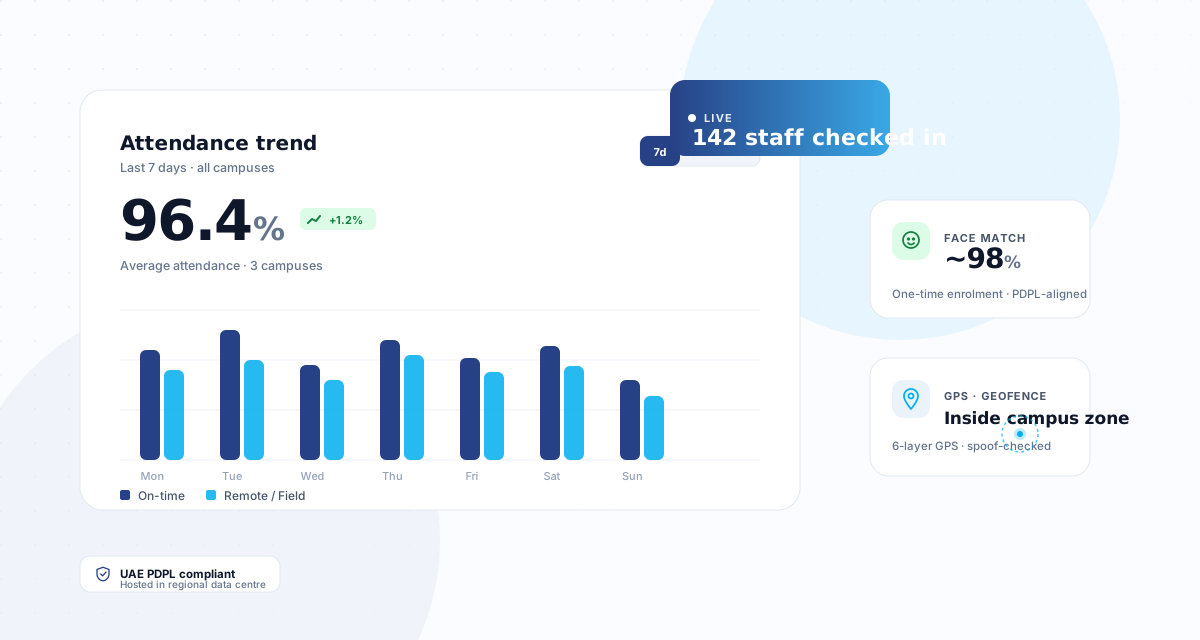
Managing employee attendance in the UAE is not just an operational task — it is a legal obligation. With the Wage Protection System (WPS), UAE Labour Law regulations, and UAE Labour Law requirements, businesses of every size need a reliable, accurate attendance system. This guide covers everything you need to know about choosing, implementing, and getting value from an attendance system in the UAE in 2026.
Why UAE businesses need an attendance system
The UAE has some of the most structured workforce regulations in the region. Federal Decree-Law No. 33 of 2021 requires employers to keep accurate records of working hours, overtime, leave, and rest periods.
The Ministry of Human Resources and Emiratisation (UAE Labour Law) conducts inspections and can request attendance records at any time. Failing to produce accurate records leads to fines, work-permit suspensions, and company-classification downgrades.
Compliance goes further. The Wage Protection System (WPS) requires salaries to flow through approved channels. WPS 2.0 added Central Bank integration that cross-checks payments against contracts. If attendance data is wrong, payroll is wrong, and WPS flags the discrepancy. Attendance accuracy is now a direct input to payroll compliance.
There are also practical reasons. Manual tracking — paper registers or basic spreadsheets — is prone to errors, buddy punching, and late submissions. For multi-site businesses, rolling up manual records into a single payroll report is slow and unreliable. An automated system removes these problems at the source.
Types of attendance systems available
Attendance systems in the UAE market fall into several categories, each with distinct advantages and limitations.
Fingerprint biometric systems are the most widely deployed hardware-based solution. They use a dedicated scanner at each location entrance. The hardware typically costs AED 1,500 to 5,000 per device, plus installation and maintenance. Fingerprint systems are reliable for single-location offices but have known limitations: sensors degrade over time, they struggle with wet or dirty hands (common in construction and cleaning), and they require physical contact — a concern that gained prominence during the pandemic.
Card-based and PIN systems use RFID cards, proximity cards, or numeric codes. These are inexpensive but highly vulnerable to buddy punching — one employee can easily swipe another's card. They provide no identity verification, only credential verification.
GPS-based mobile systems use the employee's smartphone to capture location at check-in and check-out. A geofence (virtual boundary) is set around each work location, and the system verifies that the employee is within that boundary when they clock in. GPS systems require no hardware purchase and scale easily to multiple locations. They are particularly well-suited for companies with distributed workforces — construction, security, cleaning, and field services. This hardware-free attendance approach is now the default for UAE businesses that need to cover more than one location.
Face recognition systems use the smartphone camera or a dedicated tablet to verify employee identity at check-in. Combined with GPS, this creates a dual-verification system: the employee must be at the right place (GPS) and be the right person (face). Phone-based face recognition systems are increasingly popular because they eliminate hardware costs entirely.
Cloud-based platforms combine GPS, face recognition, and centralised dashboards into a single system accessible from any browser. All data is stored centrally, reports are generated automatically, and administrators can monitor attendance across all locations in real time. Most modern attendance systems in the UAE are cloud-based. For a detailed comparison, see our article on cloud vs on-premise attendance systems.
Key features to look for
When evaluating attendance systems for UAE operations, prioritise these capabilities:
- GPS geofencing — essential for multi-site operations. Each location should have its own geofence with a configurable radius.
- Face recognition — identity verification that prevents buddy punching, the single biggest source of attendance fraud.
- Real-time dashboards — managers see who is present, late, or absent at a glance, without waiting for end-of-day reports.
- Automated overtime calculation — must align with UAE Labour Law (regular overtime versus weekend and holiday rates use different multipliers).
- Leave management integration — approved leave should reflect in attendance records automatically, with no manual adjustment.
- Payroll export — output formats that match your payroll system and WPS requirements save hours of data preparation each month.
- Mobile access for employees — staff check in, view records, and submit correction requests from their own phones.
- Multi-branch support with role-based access — branch managers see only their site; head office sees everything.
- Audit trails — every check-in, correction, and approval is logged for inspection readiness.
Pricing overview
Attendance system pricing in the UAE follows one of two models.
Hardware-based systems require upfront capital. Expect AED 2,000–10,000 per device, plus an annual maintenance contract worth roughly 10–15 percent of the hardware cost.
Cloud-based systems use a per-employee-per-month subscription, typically AED 5–25 per employee. Many providers offer a free tier for small teams (under 25 staff) with basic features, plus premium tiers that add analytics, API integrations, and priority support.
When comparing costs, look at total cost of ownership — not just the sticker price. Hardware needs replacing every 3–5 years. On-premise servers need IT support. Automation saves admin time every month. Cloud systems usually have a lower total cost once a business has more than one location.
How to choose the right system
Start with your operational reality. A single-office company with 50 staff has very different needs from a construction firm with 500 workers across 8 sites. Use this checklist:
Before any of that, settle which product you are actually buying. Three teams inside one organisation ask for “a staff system” and mean three different things — HRMS, workforce management or attendance sets out how to tell them apart in one sentence, which saves shortlisting products that were never comparable.
- Number of locations — determines whether hardware or GPS makes more sense.
- Workforce type — office, field, shift, or mixed. Each shapes the daily check-in flow.
- Payroll integration — does the system export in the format your payroll provider accepts?
- Data sovereignty — under UAE PDPL, ask each provider which region processes your data and what Article 22 safeguards apply to transfers out of the UAE.
- Uptime and support — attendance is daily-use. Downtime directly impacts payroll accuracy.
- Pilot period — request a trial before committing to a long-term contract.
For businesses headquartered locally, our guide to the best attendance system in Dubai walks through vendor shortlisting in detail.
Implementation best practices
Successful rollouts follow a predictable pattern:
- Pilot one branch first. Validate the setup with a single department or site before going company-wide.
- Configure schedules first. Set up shift patterns, leave policies, and working hours before the first staff member checks in.
- Train managers, not staff. Managers are the primary dashboard users. Staff only need a 2-minute walkthrough.
- Communicate clearly. Explain both the what and the why. People accept new systems faster when they understand the reason.
- Run in parallel for one cycle. Keep the old system running alongside for one payroll cycle to verify accuracy.
- Monitor adoption. Track first-week check-in rates. Address failures the same day they happen.
The compliance connection
In the UAE, attendance is not an isolated HR function — it connects directly to WPS compliance, UAE Labour Law inspection readiness, labour law adherence, and visa/work permit processing. An accurate, automated attendance system is the foundation that supports all of these requirements. Investing in the right system is not just about operational efficiency; it is about protecting your business from regulatory risk.
Looking for a complete attendance solution for UAE businesses?
CampusTrack provides GPS geofencing, face recognition, and payroll-ready reports designed for UAE compliance requirements.
Learn how CampusTrack worksFrequently asked questions
What is the best attendance system for UAE businesses in 2026?
The best attendance system in the UAE in 2026 is one that satisfies UAE Labour Law record-keeping, supports the WPS payroll cycle, complies with the UAE Personal Data Protection Law (PDPL), and works without dedicated biometric hardware. Cloud GPS + face verification platforms have become the default because they cost less than fingerprint scanners and roll out across multi-site organisations in under two weeks.
Do UAE companies still need fingerprint or biometric hardware?
No. The UAE Labour Law does not require any specific attendance hardware — only that working hours, overtime, and leave are accurately recorded and retained for inspection. Phone-based GPS plus face verification produces the same audit trail as fingerprint scanners with lower cost, no hygiene concerns, and no maintenance contracts.
Does CampusTrack comply with UAE Labour Law and PDPL?
Yes. CampusTrack records hours, overtime, breaks, and leave per Federal Decree-Law No. 33 of 2021. Biometric face data is processed under UAE PDPL — encrypted at industry-standard strength, stored on enterprise-grade cloud infrastructure, and never sold or shared. Each user’s face template can be deleted on request, fulfilling PDPL’s right-to-erasure provisions.
How long does it take to deploy an attendance system in the UAE?
Most UAE companies move from contract signature to live attendance in 7–14 days. The platform is SaaS — no on-premise hardware to procure, no approved cabling, no IT install. The longest single step is usually staff communication and the face-registration window, which a small team can complete in two days.