
By CampusTrack Team
Biometric Attendance Without Hardware: How Phone-Based Systems Work
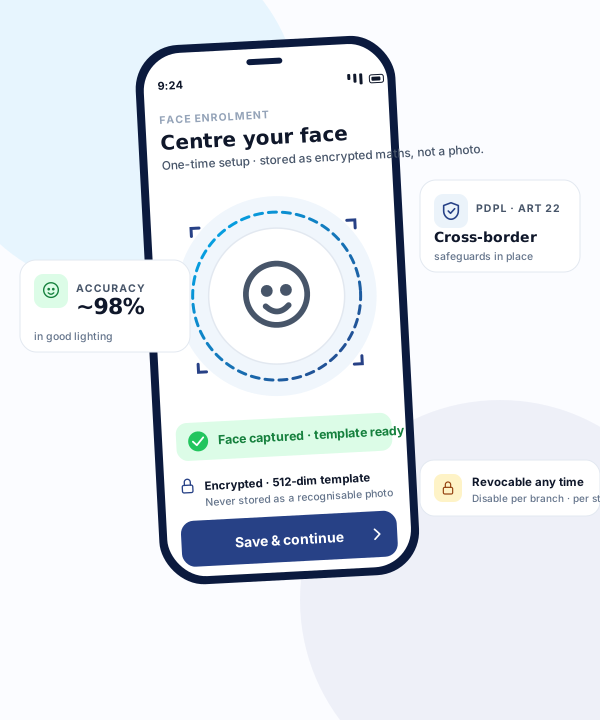
For years, biometric attendance meant hardware: fingerprint scanners mounted at office entrances, iris scanners in high-security facilities, or dedicated face recognition terminals. These devices work, but they come with significant costs — hardware purchase, installation, maintenance, and the operational headaches of managing physical devices across multiple locations. A new generation of phone-based biometric systems is changing this equation entirely.
How traditional biometric systems work
Traditional biometric attendance requires dedicated hardware at each location. A fingerprint scanner, for example, captures the employee's fingerprint pattern, matches it against a stored template, and records the timestamp. The device is typically connected to a local server or the cloud via network. Each device costs approximately AED 1,500 to 5,000, and organisations with multiple entrances or locations need multiple devices. Add installation costs, annual maintenance contracts (typically 10 to 15 percent of hardware cost), and IT support for connectivity issues, and the total cost of ownership adds up quickly.
Fingerprint systems also have practical limitations — as we explore in detail in our face recognition vs fingerprint comparison. Sensors degrade over time and need periodic replacement. Wet, dirty, or calloused hands — common in construction, cleaning, and manual labour — cause failed reads. The device becomes a shared touchpoint, raising hygiene concerns. And if the device goes offline, there is no fallback for attendance capture until it is repaired.
How phone-based biometric attendance works
Phone-based systems use the smartphone that employees already carry. The process is straightforward: the employee opens the attendance app, the app uses the phone's front camera to capture a face image, the system matches it against the enrolled face template using AI-based face recognition, and simultaneously the app captures the phone's GPS coordinates to verify the employee is within the designated geofence. Both verifications — identity (face) and location (GPS) — happen in seconds, and the attendance record is stored in the cloud.
This approach provides dual-factor verification without any hardware installation. The employee's phone is the biometric device, the GPS sensor, and the communication channel — all in one. See the full overview of hardware-free attendance for how this is deployed in practice.
Cost comparison
The cost difference is substantial. A hardware-based setup for a company with 5 locations might require 10 fingerprint devices (2 per location for entrance and exit) at AED 3,000 each — AED 30,000 in hardware alone, plus installation and annual maintenance. A phone-based system for the same company requires zero hardware investment. The cost is a per-employee monthly subscription, typically AED 5 to 20 per employee. For a 200-employee company, this works out to AED 1,000 to 4,000 per month, with no upfront capital expenditure and no maintenance contracts.
Scaling is where the difference becomes even more pronounced. Adding a new location with a hardware system means purchasing and installing new devices. With a phone-based system, adding a new location means creating a new geofence in the admin dashboard — a 5-minute configuration task with zero hardware cost.
Hygiene and contactless operation
Phone-based systems are inherently contactless. Each employee uses only their own device — there is no shared surface that hundreds of people touch daily. This is not just a pandemic-era concern; in industries like food service, healthcare, and education, minimising shared contact points is a permanent operational standard. Face recognition via phone camera requires no physical contact at all.
Scalability for multi-site operations
Companies with distributed workforces — construction firms with multiple project sites, security companies with dozens of client locations, cleaning firms servicing different buildings, school groups with several campuses — benefit the most from phone-based systems. Each site gets its own geofence, and employees check in using their phones wherever they are assigned. There is no need to install, maintain, or troubleshoot hardware at each location. When a project ends and a new site opens, the geofence is simply reconfigured.
This flexibility is particularly valuable in the UAE, where construction projects are temporary by nature and security/cleaning contracts change frequently. A hardware investment at a site that closes after 18 months is a sunk cost. A geofence that is deactivated and recreated elsewhere costs nothing. The same pattern applies to any attendance system in Dubai servicing distributed operations.
Accuracy and anti-fraud measures
A common concern with phone-based systems is fraud prevention. Can an employee use a photo instead of their real face? Can they fake their GPS location? Modern phone-based systems address both concerns. Liveness detection ensures that the face presented to the camera is a real, live person — not a photograph or video. GPS spoofing detection identifies when an employee attempts to use a fake location app. Together with server-side validation, these measures provide approximately the same level of anti-fraud protection as dedicated hardware, and in some cases better — since the dual verification (face plus GPS) is inherently stronger than fingerprint alone.
When hardware still makes sense
Phone-based systems are not universally superior. In environments where employees do not carry smartphones — some industrial settings, for example — a shared device remains necessary. For very high-security facilities requiring iris scanning or multi-factor physical access control, dedicated hardware serves a different purpose beyond attendance. And in locations with poor cellular or GPS coverage (deep underground facilities, remote desert sites), GPS-based verification may be unreliable. For the vast majority of UAE businesses, however, phone-based biometric attendance provides better coverage, lower cost, and greater flexibility than traditional hardware.
Looking for hardware-free biometric attendance?
CampusTrack uses phone-based face recognition and GPS geofencing — no fingerprint scanners or hardware installation required.
Explore face recognition attendanceRelated Solutions
Frequently asked questions
Is phone-based face verification as accurate as a dedicated terminal?
In good conditions the practical difference is small — approximately 98% in good conditions is a fair expectation for face matching either way. What differs more is the failure path: a terminal blocks the queue behind it, while a phone can fall back to supervisor confirmation.
What about staff who do not have a smartphone?
A shared tablet at the entrance covers them, and one device serves a large group because a check-in takes seconds. Budget for a few rather than treating those staff as an exception to be argued about later.
Do we still need anything at the gate?
Only if you need to control physical access. Attendance and door control are separate problems that hardware vendors sell together. If the door lock is the real requirement, keep the reader for the door and let attendance move to phones.