
By CampusTrack Team
Face Recognition vs Fingerprint Attendance in Schools
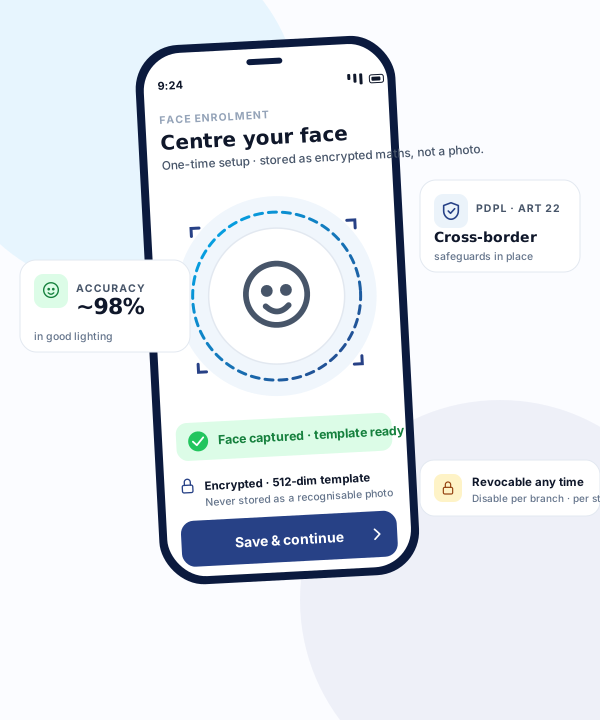
Schools across the UAE are re-evaluating how they verify staff identity at check-in. The choice increasingly comes down to two approaches: traditional fingerprint scanners or newer face recognition systems. Each has trade-offs that matter specifically in school environments.
Why schools still use fingerprint scanners
Fingerprint scanners became standard in UAE schools over the past decade because they were simple and familiar. A device is mounted at the entrance, staff scan their finger, and attendance is logged. The technology was proven in corporate environments and adapted to schools with minimal configuration.
The familiarity factor is real — administrators, IT staff, and teachers understand how it works. Switching away means change management, and schools are understandably cautious about disrupting something that appears to work.
The problems fingerprint scanners create in schools
School environments are not corporate offices. Several issues surface when fingerprint systems run in education settings:
- Morning queues: Schools have a concentrated arrival window. 80 to 150 staff members arriving within 15 minutes creates bottlenecks at scanner locations, especially when a single device serves an entire campus.
- Hygiene concerns: Every staff member touches the same surface multiple times daily. In a school with children, parents, and visitors in close proximity, shared-touch devices remain a concern.
- Hardware failures: Scanners break. When a device goes offline, there is no attendance record until IT resolves the issue — which may take hours or days depending on vendor response times. A hardware-free attendance approach removes this single point of failure entirely.
- Multi-campus limitations: Each campus needs its own hardware installation. Staff who float between campuses cannot check in at a branch where they are not registered.
- Outdoor duty staff: Teachers on bus duty, gate duty, or field supervision are not near the scanner. Their attendance is often recorded manually or not at all.
How face recognition attendance works
Face recognition attendance uses the camera on a staff member's own smartphone to verify identity at check-in. The system captures a live image, compares it against a registered face template (stored as a mathematical embedding, not a photograph), and confirms identity in under two seconds.
When combined with GPS geofencing, the system simultaneously confirms that the staff member is physically within the school campus boundary. This dual verification — identity plus location — provides stronger assurance than fingerprint alone.
Side-by-side comparison
| Factor | Fingerprint | Face Recognition + GPS |
|---|---|---|
| Hardware needed | Scanner per entrance | None — uses staff phones |
| Setup time | 4-8 weeks | 1 day |
| Hygiene | Shared touch surface | Contactless |
| Morning queues | Bottleneck at device | Parallel — everyone checks in simultaneously |
| Multi-campus | Separate install per campus | Works at any registered campus |
| Outdoor duty staff | Cannot check in | Check in from anywhere on campus |
| Location verified | No | Yes — GPS geofence |
| Monthly cost | AED 2,000+ (hardware + maintenance) | Flat subscription |
Real-world challenges specific to school environments
Schools operate differently from offices. The attendance system needs to handle: split shifts for teaching and admin staff, grace periods that differ by role, bus duty and gate duty where staff are not at a fixed location, exam supervision days with altered schedules, and Ramadan timing adjustments.
Fingerprint hardware has no awareness of these contexts — it simply records a scan. A cloud-based platform can apply shift rules, grace periods, and schedule variations automatically.
How to evaluate the right system for your school
Before choosing, ask these questions:
- Does your school have staff working across multiple campuses or outdoor locations?
- How many minutes does your current morning check-in take at peak?
- What happens to attendance records when the scanner device goes offline?
- Can your current system generate inspection-ready compliance reports instantly?
- What is your total annual cost including hardware maintenance and replacements?
If any of these reveal friction, the school environment is likely better served by a contactless, cloud-based approach. Learn more about how biometric attendance works without hardware.
The question neither comparison usually asks
Both are biometric, and that is the part most comparisons skip past. Whichever a school chooses, it is processing a special category of personal data about its employees, and the obligations follow the data rather than the technology: consent has to be specific and separable rather than folded into a contract, retention has to be defined and actually enforced, and a member of staff who declines needs a route that still lets them record attendance.
The useful differentiator is therefore not accuracy but what happens to the biometric afterwards — where the matching runs, whether the data leaves your vendor, and whether the template can expire independently of the attendance record it verified.
See contactless attendance in action
CampusTrack combines GPS geofencing with optional face verification — no hardware, no queues, no maintenance contracts.
Book a demoFrequently asked questions
Does face recognition work for staff wearing glasses or a face covering?
Glasses are routine. A covering that hides the face will not match, which is a policy question rather than a technical one — decide in advance what the alternative check-in path is, and tell people what it is before the first morning.
How accurate is face recognition in practice?
Approximately 98% in good conditions is a fair expectation. Accuracy matters less than what happens on a failed match: a system that queues the person for supervisor confirmation and one that strands them at the door have the same number and completely different consequences.
Is a fingerprint template safer than a face template?
Neither is inherently safer. What matters is that the system stores a mathematical template rather than an image, that consent is recorded, and that there is a retention and deletion schedule someone actually applies.