
By CampusTrack Team
GPS vs Fingerprint Attendance: Which Is Better for Multi-Site Companies?
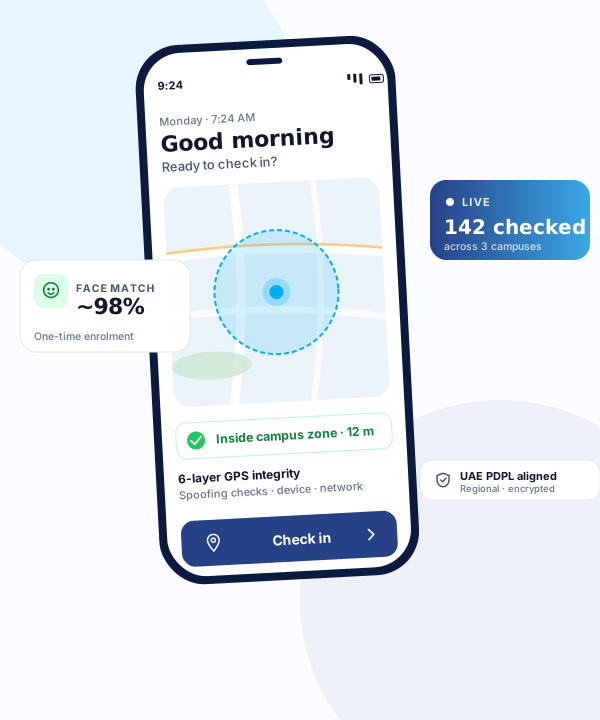
Workforce attendance technology has evolved significantly over the past decade. Two dominant approaches have emerged: GPS geofencing (using mobile devices to verify location) and fingerprint biometric scanners (using physical readers at entry points). Each has strengths, and the right choice depends on how your organisation operates.
How GPS geofencing works
GPS-based attendance uses a virtual boundary (geofence) around a work site. When an employee checks in via a mobile app, the system verifies their GPS coordinates fall within the defined perimeter. Some systems add a second verification layer such as face recognition to confirm the person matches their profile. No physical hardware is installed at the site.
How fingerprint attendance works
Fingerprint systems use a biometric reader mounted at the entrance. Employees place a finger on the scanner, and the device matches the print against an enrolled database. The hardware records the timestamp and transmits it to a central system, either over a local network or via cloud sync.
Hygiene and contactless operation
Fingerprint scanners require physical contact, which raises hygiene concerns in shared workplaces. Post-pandemic awareness has made many organisations reluctant to deploy shared-touch devices. GPS-based systems are entirely contactless — employees use their own mobile phones, eliminating shared surface contact. This is the foundation of hardware-free attendance as an operational model.
Multi-site scalability
This is where the two approaches diverge most. Fingerprint systems require a physical reader at every location. For a company with 10 sites, that means 10 or more devices to purchase, install, maintain, and replace. Each device needs power, network connectivity, and periodic firmware updates. GPS geofencing scales by simply defining a new geofence in the admin dashboard — no hardware shipment, no installation visit, no maintenance contract. Adding a new site takes minutes rather than weeks.
Buddy punching prevention
Buddy punching — one employee clocking in for another — is a persistent problem in both systems. Fingerprint scanners are inherently resistant because biometrics are unique to each person (though silicone moulds have defeated some lower-end readers). GPS systems alone are more vulnerable because a colleague could check in using another person's phone. However, GPS combined with face recognition effectively eliminates buddy punching: the system verifies both where you are and who you are.
Cost comparison
Fingerprint readers typically cost AED 1,500 to 5,000 per device, plus installation and ongoing maintenance. For multi-site operations, hardware costs multiply quickly. GPS-based systems require no hardware investment — employees use their existing smartphones. The cost structure shifts to a per-employee software subscription, which is generally more predictable and lower overall, especially for distributed organisations.
UAE context and outdoor environments
In the UAE, many industries operate across distributed locations: construction sites, security deployments, facility management contracts, and multi-campus schools. Summer temperatures regularly exceed 45 degrees Celsius, and outdoor fingerprint readers can malfunction in extreme heat or when employees have sweaty or dusty fingers. GPS systems are unaffected by environmental conditions since the verification happens through the phone.
When fingerprint is the better choice
Fingerprint scanners remain effective for single-location operations with a controlled entry point — a factory gate, a corporate office lobby, or a warehouse entrance. If all employees enter through one door and the organisation has the infrastructure to support the hardware, fingerprint remains a reliable and proven solution.
When GPS is the better choice
GPS geofencing is the stronger option for organisations with multiple sites, mobile workforces, or frequent site changes. It eliminates hardware dependencies, scales instantly, and when combined with face recognition, matches or exceeds the identity verification strength of fingerprint systems. For a deeper look at how geofencing works, see our guide on geofencing for attendance tracking.
Where each one genuinely fails
Neither approach is universally better, and a comparison that says otherwise is selling something. Fingerprint fails where staff move between sites, where a terminal creates a queue at a shared arrival time, and where hygiene or hardware maintenance is a live concern. GPS fails where staff do not carry a phone, where a school does not want to depend on personal devices, and where a site has poor signal and no connectivity fallback.
The practical question is not which is better in the abstract but which failure mode your school can actually absorb. A single-site school with a working terminal and a fully on-site workforce is not in a hurry. A group with staff crossing campuses is.
Looking for a GPS-based attendance system?
CampusTrack uses GPS geofencing with face recognition to deliver accurate, hardware-free attendance across multiple sites.
Learn how CampusTrack worksFrequently asked questions
Which suits outdoor UAE sites better?
GPS, usually. Heat, dust and wet or worn hands are the conditions fingerprint readers handle worst, and outdoor sites rarely have anywhere sensible to mount and power a terminal.
Is fingerprint ever the better choice?
Yes, in a genuinely narrow case: one indoor site, everyone passing one door, and no multi-site plan. That is where the terminal’s weaknesses do not apply and its simplicity is an advantage.
Can we run both during a transition?
Mixed estates are common. Decide which system holds the record of truth before you run both, otherwise the transition period produces two sets of hours that somebody has to reconcile by hand.