
By CampusTrack Team
Return to Office Attendance Tracking: How to End Coffee Badging
As return-to-office mandates become the norm across industries, a new form of attendance gaming has emerged: coffee badging. Employees badge into the office, grab a coffee, stay for 30 minutes to an hour, then leave to work from home. The badge system records them as present. The reality is different.
What is coffee badging?
Coffee badging refers to the practice of briefly appearing at the office to register attendance — typically by swiping an access badge — then departing shortly after. The term gained traction in 2024 as companies implemented return-to-office policies but relied on badge swipe data as their only verification. Surveys by multiple workforce research firms suggest that between 50 and 60 percent of hybrid workers have engaged in some form of coffee badging.
The scale of the RTO tracking problem
The shift back to in-office work is significant. According to industry surveys, approximately 69 percent of companies now have some form of return-to-office requirement, up from around 50 percent in 2024. Many tie office attendance to performance reviews, promotions, or even continued employment. But enforcement varies widely. Companies with badge-only tracking have limited ability to distinguish between an employee who was in the office for 8 hours and one who was there for 45 minutes.
Why badge-only systems fail
Traditional access badges record a single event: the swipe. They tell you someone entered the building at 8:47 AM. They do not tell you when that person left, whether they were at their desk or in the lobby, or whether they stayed for the required hours. Some badge systems record exit swipes, but tailgating (following someone through a door) and propping doors open create gaps in the data. Badge systems were designed for physical security, not attendance verification.
GPS geofencing for office attendance
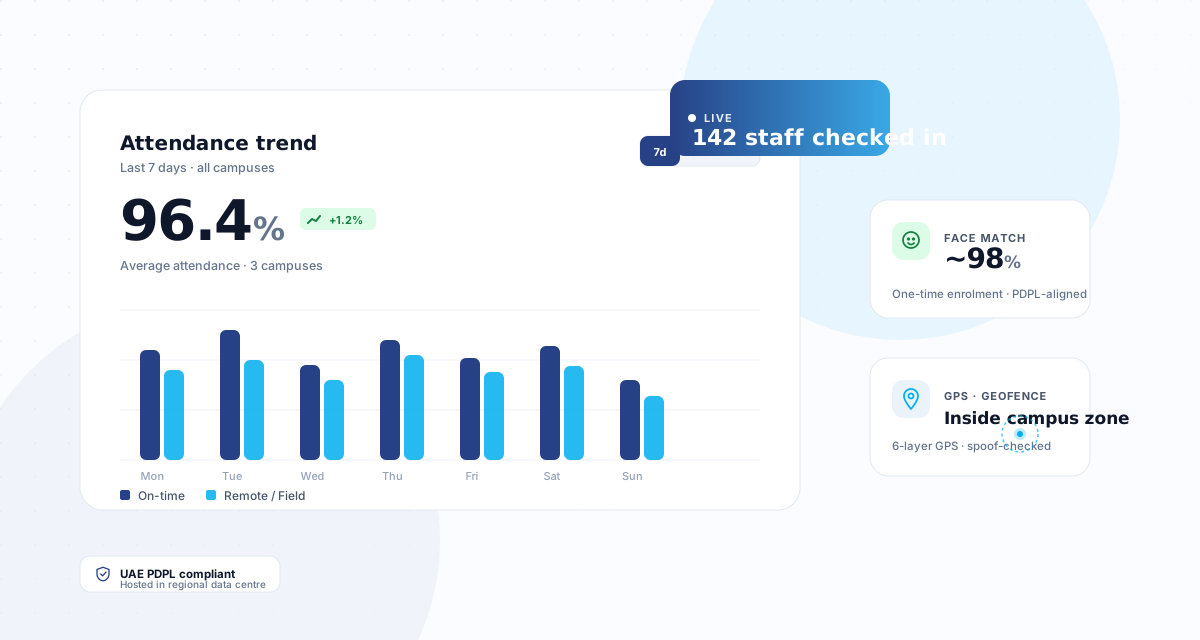
GPS geofencing for corporate offices offers a more complete picture. A geofence is defined around the office building or campus. Check-in is recorded when the employee's device enters the geofence and they actively confirm their arrival through the app. Check-out is recorded when they confirm departure or when the device leaves the geofence. The system captures both arrival and departure, making it possible to calculate actual hours on-site — not just a single timestamp.
Presence verification beyond check-in
Some organisations go further with periodic presence checks. These can take various forms: a mid-day check-in prompt through the app, Wi-Fi network connection verification (if the employee's device is connected to the office network, they are on-site), or randomised check-in requests that require a brief face verification. These approaches confirm sustained presence rather than momentary appearance, though they must be balanced against employee experience and trust.
Hybrid schedule management
Most RTO policies are not five days a week. Common patterns include three required office days with two remote days, or team-based schedules where different departments have different in-office days. An effective attendance system should allow administrators to define which days each employee or team is expected in-office, track compliance against the defined schedule (not just raw attendance), generate reports showing in-office compliance rates by team, department, or individual, and distinguish between authorised remote days and missing office days.
Privacy considerations
Any attendance tracking system that uses GPS or continuous monitoring raises legitimate privacy concerns. Best practices include collecting location data only during defined work hours, not tracking employees on remote work days or outside business hours, being transparent about what data is collected and how it is used, providing employees access to their own attendance data, complying with applicable data protection laws (UAE PDPL, GDPR for international operations), and using the least invasive method that achieves the goal.
The management challenge
Technology alone does not solve the coffee badging problem. If employees are gaming the system, it often signals a deeper issue — either the RTO policy does not have clear business justification, or the work itself can be done equally well remotely. The most effective approach combines reliable attendance data with transparent communication about why in-office presence matters and what the expectations are. Data without context creates resentment; expectations without data create ambiguity. For a broader look at attendance solutions in the UAE, read our complete guide to attendance systems.
Looking for a GPS-based attendance system?
CampusTrack uses GPS geofencing with check-in and check-out verification to provide accurate, auditable office attendance data.
Learn how CampusTrack worksFrequently asked questions
Is tracking office attendance intrusive?
It depends entirely on what you record. Presence on the days someone is expected is defensible. Continuous location through the day is a different thing that needs a different justification, and treating them as the same is how a reasonable policy gets resisted.
What is coffee badging, and does it matter?
Badging in and leaving shortly afterwards. It only matters if your policy is about presence for a duration rather than attendance on a day — so decide which one you actually mean before choosing how to measure it.
How do we handle hybrid schedules fairly?
Record the expectation alongside the actual, so the comparison is against what each person agreed rather than a blanket rule. Without that, part-time and flexible arrangements read as non-compliance when they are nothing of the kind.