
By CampusTrack Team
Choosing the Best Attendance System for Security Companies in UAE
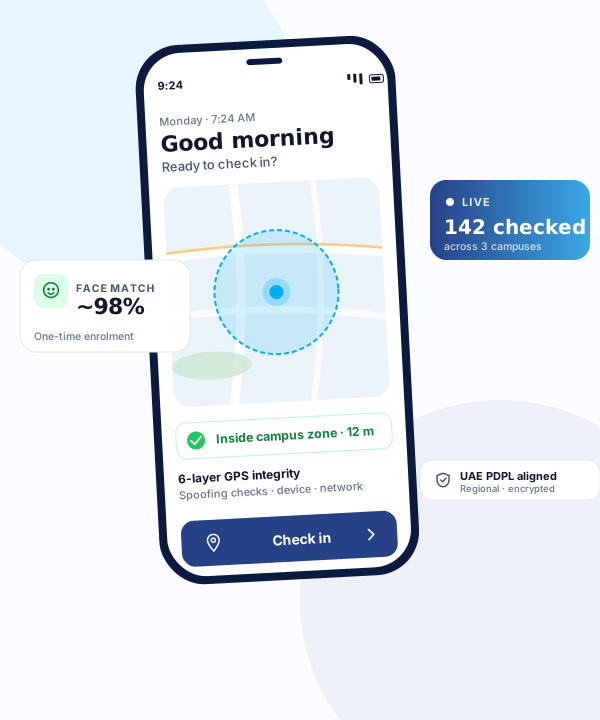
Security companies in the UAE operate in conditions that break most standard attendance systems. Guards work 24/7 rotational shifts across dozens of client sites, often in locations without fixed infrastructure. A system designed for a 9-to-5 office will fail in this environment. Here is what to look for when evaluating attendance solutions for security operations.
The unique challenges of security workforce management
Security companies face a distinct set of attendance challenges that differentiate them from most other industries. Guards are deployed across multiple client sites that the security company does not own or control. Shifts run around the clock — 8-hour, 10-hour, or 12-hour rotations — requiring precise handover tracking. Guard rotation means the same person may work at different sites each week. No-shows are a critical operational risk: if a guard does not arrive, the client site is unprotected. Subcontracted guards add another layer of verification complexity.
Why traditional systems fall short
Fingerprint scanners require installation at every client site, which is often impractical since the security company does not control the premises. Paper-based sign-in sheets are easily falsified and require manual collection from each site. RFID cards can be shared between guards, enabling buddy punching. Basic clock-in systems without location verification cannot confirm the guard is actually at the assigned site rather than checking in from elsewhere. For a detailed comparison of these technologies, see our article on GPS vs fingerprint attendance.
Feature 1: GPS verification at check-in
The system must verify the guard's physical location at the moment of check-in and check-out. GPS geofencing for security operations creates a virtual perimeter around each client site. A check-in is only accepted when the guard's device is within the defined boundary. This confirms presence without requiring any hardware at the client location — critical for security companies managing 50 or more sites. For the broader case on why guard post check-in is moving to phones, see our guide to attendance systems without hardware.
Feature 2: Face recognition for identity
GPS confirms where the guard is, but not who they are. Face recognition adds the identity layer. At check-in, the guard takes a photo through the app, and the system matches it against their enrolled profile. This eliminates buddy punching and provides photographic evidence of who was on-site — a record that can be shared with clients as proof of service delivery.
Feature 3: Real-time no-show alerts
When a guard has not checked in within a defined window after shift start, the system should automatically alert the operations manager. In security, a 30-minute gap in coverage can have serious consequences. Real-time alerts enable rapid response — dispatching a replacement guard before the client notices the gap.
Feature 4: Multi-site dashboard
Operations managers need a single view showing the status of every site. Which sites are staffed, which have pending check-ins, which have overtime situations developing. A multi-site dashboard replaces the manual process of calling supervisors at each location and provides an auditable, real-time picture of the entire operation.
Feature 5: Shift scheduling and rotation management
The system should support complex shift patterns including 24/7 rotations, split shifts, and variable schedules per site. Guard assignments should be visible in advance so that both the guard and the site supervisor know who is expected. When rotations change — due to leave, termination, or client requests — the system should reflect the change immediately.
How to evaluate vendors
When comparing attendance systems for security operations, ask these questions. Does the system work without installing hardware at client sites? Can it handle 100+ geofences simultaneously? Does it support offline check-in for sites with poor connectivity? Can it generate client-specific attendance reports (for SLA reporting)? Does it integrate with your payroll system for accurate overtime calculation? Is the mobile app lightweight enough to run on basic smartphones? What is the face recognition accuracy rate in variable lighting conditions?
Who you will actually be comparing
A security operation shortlisting in the UAE usually ends up looking at three different kinds of product, and they answer different questions. UAE HR platforms — Bayzat, PalmHR, Yomly, ZenHR — are strong on the employment record, WPS and leave, with attendance as one module among many. Global HR platforms such as BambooHR, HiBob or Personio are strong on the office workforce and lighter on the multi-site, non-desk reality of guarding. Time-and-attendance specialists, whether software-first products like Jibble or hardware-led biometric systems sold through local integrators, go deepest on shifts and time-cards but stop short of the lifecycle.
The question that separates them for a security company is not on any feature matrix: what happens at a client site where you cannot install hardware and the guard has one bar of signal. Ask each vendor to demonstrate exactly that, at a real site, before anything else.
The business case
For a security company with 200 guards across 40 client sites, even a 3 percent reduction in payroll leakage from buddy punching and no-shows can save AED 200,000 or more annually. Add the operational efficiency of automated reporting, reduced manual reconciliation, and faster client invoicing, and the ROI on a modern hardware-free attendance system is typically achieved within the first quarter.
Looking for a GPS-based attendance system?
CampusTrack provides GPS geofencing, face recognition, and multi-site dashboards built for distributed workforce operations.
Learn how CampusTrack worksFrequently asked questions
Can guards check in at a client site where we cannot install anything?
Yes. Phone-based check-in with a geofence around the post needs nothing installed at the site, which matters because client sites are not yours to modify. Confirm what happens when signal is poor: the useful answer is a queued check-in that keeps its original timestamp, not a failed one.
How do we prove a guard was at the post rather than nearby?
Location and identity verification at the same moment, together. Either alone is weak — a location without identity proves a phone was there, and an identity without location proves someone checked in from somewhere.
What should a client SLA report contain?
Post, shift, expected hours, actual hours, and any gap with its reason. Reports assembled monthly from raw logs are where invoicing disputes start; the record should be filterable by client as it accrues.