
By CampusTrack Team
The Case for Retiring the School Fingerprint Scanner
For over a decade, fingerprint scanners were the default choice for staff attendance in schools across the UAE. They were tangible, familiar, and straightforward. But the landscape has shifted — and schools are rethinking their approach.
The hidden cost of hardware
A single biometric terminal costs AED 2,000 to 5,000 installed. Multiply that across entrances and campuses, and the capital expenditure grows quickly. Add annual maintenance contracts, replacement parts, and the IT hours spent troubleshooting connectivity — and the total cost of ownership often surprises school administrators.
Hygiene changed the conversation
Post-2020, shared-touch surfaces in high-traffic areas became a concern for schools, parents, and staff alike. Fingerprint scanners require physical contact by every employee, multiple times daily. Some schools added sanitiser stations next to scanners — an imperfect workaround for a fundamental design limitation.
Cloud-first operations
Schools have moved their learning management, student information systems, and communication platforms to the cloud. Attendance was one of the last holdouts. GPS-based systems run on the smartphones staff already carry — no installation, no hardware procurement cycles, and no single point of failure at the school gate.
What replaces the scanner?
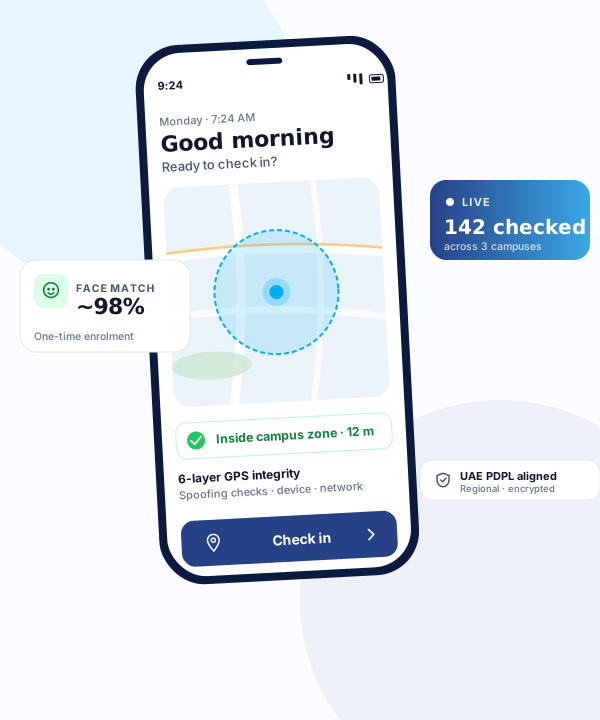
Modern attendance platforms combine GPS geofencing with optional AI face verification. Geofencing confirms the employee is within the school campus boundary. Face verification, when enabled, confirms their identity — without shared hardware. The result is the same accountability, with lower cost and greater flexibility.
The bottom line
Schools that have made the switch report faster morning check-ins, lower IT maintenance burden, and the ability to track attendance for staff working across multiple locations — something fingerprint scanners could never do. For a detailed side-by-side comparison, see our guide on face recognition vs fingerprint attendance in schools.
What fingerprint scanners still do better
Worth saying plainly, because a comparison that finds no advantages on the other side is not a comparison. A fingerprint terminal needs no phone, which matters where staff do not carry one or where a school does not want to depend on personal devices. It gives an unambiguous physical record at a fixed point, and it has no dependency on signal. For a single-site school with a stable, fully on-site workforce and a working terminal, replacing it is not urgent.
The case for moving is strongest where those assumptions break: more than one campus, staff who move between sites, peripatetic and part-time patterns, or a terminal already near the end of its life. That is when the hardware stops being a one-off purchase and starts being a recurring cost with a queue attached.
What schools find after the terminal goes
Two things come up repeatedly, and neither is the one schools expect.
The first is that the morning queue was absorbing more time than anyone had counted. A terminal processes one person at a time; two hundred staff arriving inside fifteen minutes means the last person in line is waiting minutes for a two-second action. That time was never on a budget line, so removing it does not show up as a saving — it shows up as staff arriving in classrooms earlier.
The second is that data quality improves for a reason unrelated to the technology. When a check-in is missed at a terminal, the fix is a manual entry made later by someone in the office, and manual entries accumulate until the record is a mixture of verified and asserted attendance. Reducing the number of missed check-ins reduces the number of manual corrections, and the record becomes evidence rather than an approximation.
The question to settle before switching
Not the technology — the exceptions. What happens when a member of staff forgets their phone, declines face verification, or arrives somewhere the geofence does not cover? A school that has answered those three questions before go-live has a smooth first week. One that has not will spend it improvising, and the improvisations become permanent.
A note on cost comparison
Comparing a terminal against a subscription usually understates the terminal, because the purchase price is the visible number and everything after it is not. Installation, cabling, the enrolment exercise, replacement units, the annual support contract and the administrative time absorbed by manual corrections all sit outside the quoted figure. A fair comparison runs over the working life of the hardware rather than its first year, and includes the office hours spent fixing what it missed.
See how CampusTrack replaces hardware attendance
GPS geofencing, optional face verification, and zero hardware — purpose-built for schools.
Book a demoFrequently asked questions
We already own the scanners. Is replacing them wasteful?
Only if they still do the job. What was already spent is not a reason to keep something — the question is the next three years of maintenance, replacement readers and support time, not the original invoice.
Can we keep the readers for doors and move attendance to phones?
Yes, and it is often the right answer. Door control and attendance are separate requirements that the hardware happened to bundle together, and separating them lets each be solved properly.
What do schools notice first after the terminal goes?
The queue and the correction load. The morning bottleneck disappears, and the volume of manual corrections usually drops — because a large share of them were caused by the reader failing to read in the first place.